


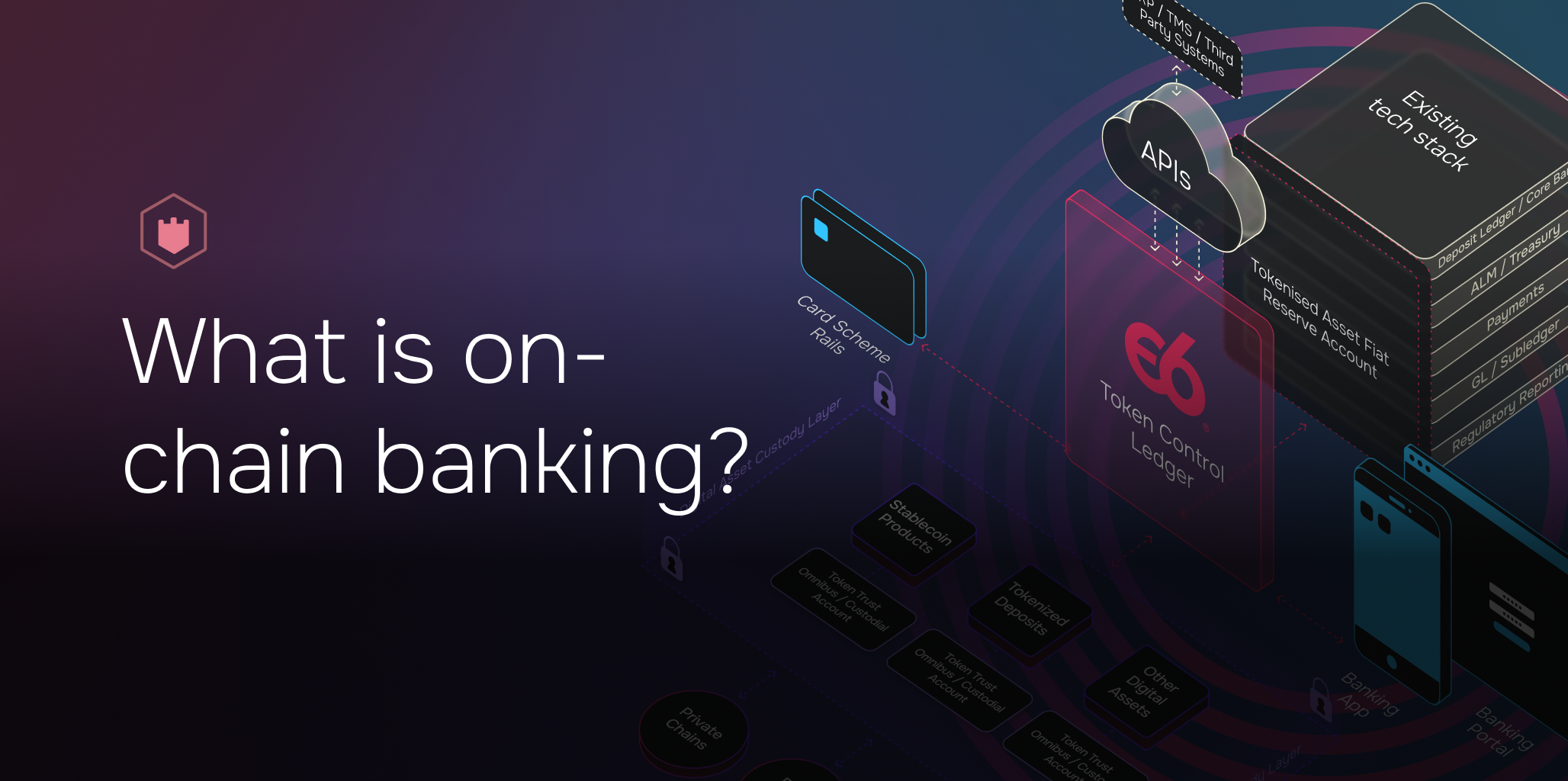
On-chain banking is the delivery of banking products and transactions through blockchain-based networks. For banks, running on-chain means connecting deposits, payments and other regulated financial products to an always-on shared ledger—while preserving control over customer balances, compliance, reconciliation and risk.
Most conversations about on-chain banking begin with products such as tokenized deposits and stablecoins. They make a compelling case for banks, as they provide benefits such as faster payments and 24/7/365 settlement.
The capabilities of tokenized deposits and stablecoins are compelling and versatile, but before adopting them, banks need to understand the fundamentals and the underlying architecture that shapes the product, integrations, participating parties, risk profile and internal processes required to support it.
The good news is that deliberate technology decisions can allow banks to adopt on-chain products while retaining many of their existing processes and controls. We’ll explore the details of integrating later in this series.
How do blockchains operate, and what does that mean for banks?
A blockchain is a shared digital ledger that records transactions and tracks assets across a network. Each group of transaction records forms a “block” that is cryptographically linked to the preceding block. Together, these blocks create a chronological chain of records that is designed to be tamper-resistant.
One of a blockchain network’s defining characteristics is that it can operate continuously, processing and verifying records in real time. Traditional core banking systems were generally designed around the concept of a business day. The system opens, processes transactions, and runs end-of-day procedures beforeclosing. Reporting, reconciliation, interest accrual and settlement are based on the assumption that there is a period when the system is not processing transactions.
This mismatch between an always-on shared ledger and a core banking system built around processing windows is one of the most important distinctions in on-chain banking. The first technical challenge is connecting a network that never closes to a system of record that does.
Banks must determine which system is the source of truth for on-chain product balances while the core is in a batch window, undergoing scheduled maintenance, or unavailable during weekends and bank holidays.
Some modern core banking platforms have addressed this challenge. For banks that haven’t, and are still operating batch-based systems, a core replacement can cost tens of millions of dollars and require a multiyear transformation. It can also create a significant opportunity cost at a time when the industry and customer expectations are changing rapidly.
Can a bank connect to one blockchain and be done?
There won’t be a single network or shared ledger that serves every institution, product and payment flow, so banks will need to connect to multiple networks. Recent initiatives illustrate this fragmentation: Swift’s shared-ledger work, The Clearing House’s consortium tokenized deposit initiative, OpenUSD and USDC are all designed for different participants, products and use cases.
If a bank integrates each network directly with its core, it will need to reconfigure that integration for every new shared ledger. It may also need to demonstrate the integrity of each implementation to regulators and network participants—while simultaneously addressing the underlying 24/7/365 processing challenge.
This complexity means that banks require an architecture that can support multiple networks without requiring a new core integration for each one.
What are the different types of blockchains?
Blockchains can generally be distinguished within two primary classifications:
- Public or private: This describes who can view and operate the network. A public blockchain, such as Ethereum, is open to wide participation. A private blockchain is operated by a defined group of participants.
- Permissioned or permissionless: This describes who can transact on the network. A permissioned network limits participation to approved, identified members. A permissionless network generally allows anyone who meets the protocol’s requirements to hold and transfer assets.
Other models include hybrid networks, sidechains and consortium blockchains, but they still reflect these two fundamental principles. Each configuration has a different risk, resilience, governance and compliance profile.
What is the token lifecycle?
Many blockchain concepts have parallels in traditional banking, but the token lifecycle introduces its own terminology:
- Mint: The creation of a token representing value held or controlled by the issuer. Depending on its design, a token can include rules governing who may use it and how it may be used.
- Hold: The token and its associated value remain attributed to a customer while recorded on the shared ledger.
- Transfer: The token moves across the network from one wallet or participant to another.
- Burn: The token is permanently removed from circulation, typically when the represented value is returned or extinguished.
- Redeem: The holder exchanges a tokenized deposit or other redeemable token for the underlying funds. Redemption generally results in the corresponding token being burned.
This lifecycle helps ensure that the issuer’s token supply and exposure do not diverge from the value backing the tokens.
The process is familiar in principle, but it is not native to many core banking systems. A traditional core records and manages the underlying deposit. In an on-chain model, a corresponding token may be minted against that value and transferred without the original deposit moving between accounts in the same way.
When a bank issues its own instrument, the supply of tokens must remain synchronized one-to-one with the value backing them.
What partners are required?
As in other areas of banking, specialized providers support different parts of the blockchain ecosystem. A bank may need to assemble several layers:
- Custody and wallet layer: This layer safeguards cryptographic keys and manages the bank’s on-network positions. Providers include Fireblocks, BVNK and Utila, although some banks have built their own capabilities. These providers help institutions support protocol changes, including hard forks—non-backwards-compatible changes that require participants to upgrade their software.
- Network or shared-ledger layer: This is the infrastructure that records and moves tokens between wallets, customers and participating institutions.
- Trading, exchange, liquidity and tokenization layer: These providers support use cases involving assets such as cryptocurrencies and securities.
- Card and acceptance layer: The utility of an instrument depends on where it can be used. Some institutions therefore connect on-chain products to existing payment rails, including card networks, enabling customers to spend token-backed value through familiar acceptance channels.
The bank’s role is to integrate these layers and orchestrate, attribute and reconcile transactions in an auditable way.
What products can run on-chain?
The same architectural principles apply to several products when running on-chain, including:
- Tokenized deposits
- Bank-issued stablecoins
- Third-party stablecoins
- Tokenized securities and other digital assets
This list isn’t exhaustive, but rather a key starting point for mass adoption. Each product has its own regulatory treatment, risk profile and economic model.
One cost specific to many on-chain products is the gas fee: a transaction fee paid to the network and its validators or operators. Gas fees may vary and can rise sharply when a public network is congested. Permissioned networks may use different—and sometimes negligible—fee structures, but banks must still account for and manage these costs.
How is on-chain banking regulated?
Regulatory clarity is a central consideration for banks, but the applicable rules vary by product, jurisdiction and network. It’s worth noting that the chains themselves aren’t regulated, while the attached products are.
Tokenized deposits generally remain within existing banking and deposit regulations, which may provide banks with a more familiar path to market. Stablecoins may fall under newer, product-specific frameworks, such as the GENIUS Act in the United States.
Risk appetite will also vary. Private enterprises and newer or smaller financial institutions may accept different levels of risk than larger, more established banks in the same market.
Fundamental compliance obligations still apply. For example:
- Anti-money laundering and sanctions screening must cover wallet addresses as well as customer identities.
- Funds must be appropriately segregated to prevent multiple claims against the same underlying value.
- Token supply and reserves must remain synchronized.
- Transactions and balances must be auditable.
- Reporting obligations must be met.
- Risk frameworks must be actively managed and controlled.
The specific requirements may change according to the product and network, but responsibility ultimately remains with the bank—not the blockchain.
What about security?
Blockchain security depends heavily on how cryptographic keys are managed. On a shared ledger, control of the keys generally means control of the assets.
A blockchain wallet is not a container holding money. It is an interface for managing cryptographic keys that authorize transactions involving assets recorded on the network.
Regulatory requirements may affect where and how those keys are held. In some jurisdictions, for example, regulators may require keys to remain onshore.
Wallets are commonly described as either hot or cold:
- Hot wallets are connected to a network and can sign live transactions. Their accessibility makes them operationally useful but can increase exposure to cyberthreats.
- Cold wallets are kept offline. They are generally harder to compromise remotely, but their use introduces physical-security and operational considerations.
Banks have always managed cryptographic keys, but on-chain products make key management more visible and central to everyday operations. Managing a separate wallet and set of keys for every customer can create a substantial operational burden.
One alternative is an omnibus custodial wallet. The bank holds an aggregated on-chain position for all tokens under management, while a separate internal ledger attributes the appropriate balance to each customer. The network sees the bank’s total position, and the bank maintains a detailed record of customer ownership.
The need for a dynamic internal system is why Episode Six developed the E6 Token Control Ledger.
What is the E6 Token Control Ledger?
The E6 Token Control Ledger is an always-on system that connects a bank’s core banking platform with wallets and blockchain networks. It records customer-level ownership, orchestrates the token lifecycle and reconciles the bank’s on-chain positions with the funds or assets backing them.
This approach means that going on-chain does not necessarily require a multiyear core replacement or the abandonment of the bank’s existing operating model.
The E6 Token Control Ledger can provide real-time, bank-side attribution—even when the core banking system is unavailable or running batch processes. It can also reconcile:
- Tokens held across wallets
- Customer-level balances
- The bank’s total on-chain position
- The funds or assets held in reserve
Positioned between the core platform and the wallet infrastructure, the E6 Token Control Ledger can manage minting, holding, transferring, redeeming and burning across multiple currencies and blockchain networks.
Most importantly, it allows a bank to adopt on-chain technology while retaining familiar banking processes, reconciliation practices, controls and security standards.
The network provides the infrastructure. The issuance and control layer remain the bank’s responsibility.
Next in this series on the opportunities within the blockchain is a deep dive into tokenized deposits. You can read it here.
About the Author
AJ Taylor is Senior Director of Emerging Payments at Episode Six. Since entering the cards and payments industry in 2005, he has created the world’s first airline multicurrency card and is now focusing on the next horizon of payment innovation.
About Episode Six
Episode Six is The World’s Local Processor ®. As a global provider of enterprise-grade card issuing and ledger infrastructure for financial technology companies, banks, and brands, Episode Six delivers the innovative capabilities needed to compete with disruptors and lead the market. Flexibility, adaptability, and resilience are built into the core of Episode Six's platform, ensuring clients maintain a market-leading position. Episode Six operates in over 50 countries, powering millions of accounts and billions in payments globally, with an expanding team located in the US, Canada, UK, Europe, Japan, Singapore, Hong Kong, Australia, and India. Investors include HSBC, Mastercard, SBI Investment Co Ltd, Anthos Capital, Avenir, and Japan Airlines.