


Secure and control on-chain value: Introducing Verified Backing from the E6 Token Control Ledger
Tokenized money is live, and risk is scaling along with it. Stablecoin and digital money processing systems are emerging worldwide, and the strictest systems require consistent full backing. The standard practice of periodic attestation displays a record, not the present. So how can your bank guarantee valid backing against all digital transactions?
That’s where Verified Backing from the E6 Token Control Ledger™ comes in. Verified Backing checks a bank’s own tokenized deposits and stablecoins in real time against the funds backing them, when they’re created and again when they’re redeemed.
A crucial checkpoint for verification
When your bank issues tokenized money via the E6 Token Control Ledger, the token may travel far beyond the bank’s systems. It can move between wallets, cross supportedblockchain networks and pass through a growing digital asset ecosystem. The funds behind that token, however, remain the bank’s responsibility.
Verified Backing creates a validated relationship between the tokens a bank issues and the funds backing them. It gives the bank a control point at both ends of the token lifecycle: issuance and redemption.
The bank confirms that each token was issued against valid funds, and when a token returns for redemption, it verifies that the request is genuine before releasing money.
The result is a crucial checkpoint: Funds do not move until the token is verified.
What is Verified Backing?
Verified Backing is a method for demonstrating that an issuer holds sufficient funds or assets to back the digital tokens it has issued.
Traditional approaches tend to focus on the issuer’s aggregate position. For example, an issuer may demonstrate that it holds enough reserve assets to match the total value of its outstanding tokens.
That transparency can support auditing, reporting and regulatory disclosure. But an aggregate view doesn’t necessarily connect an individual token to its backing funds or verify that token when it is presented for redemption.
Episode Six takes a new approach: verification built into the token’s funds flow. We’ve designed Verified Backing to operate bank-side within the E6 Token Control Ledger. It’sdesigned specifically for tokenized deposits, stablecoins and other tokenized payment instruments issued by the bank against its own funds or reserves.
At issuance, the system verifies that the corresponding funds are present before the token is created. At redemption, it confirms that the token was validly issued, remainsoutstanding and is authorized for redemption before funds leave the bank.
This means that nothing counterfeit gets cashed out: the counterfeit’s mode of creation and its network will not match the issuer's record of what is genuinely backed and outstanding. It is ultimately refused before being redeemed.
Why banks need control beyond the blockchain
A blockchain can record that a token moved from one wallet to another. It can provide a history of on-chain transactions and show the wallet that currently holds the token.There are various tools that are designed to operate in the blockchain. Verified Backing doesn't replace them, it enhances their capabilities. Many of the tools that are based on-chain and use off-chain data work retrospectively rather than in real-time, and are for audit attestation purposes. This record doesn’t answer every question a bank needs toaddress.
The bank still must account for:
- Whether the token was created through an authorized issuance
- If the required funds were present when it was issued
- Whether the token remains valid and outstanding
- If it has already been redeemed
- Whether the redemption request corresponds to the bank’s issuance record
- If the bank should release the underlying funds
- Issuance
- Underlying balances and reserves
- Token authorization and issuance
- Customer-level attribution
- Redemption
- Verification
- The relationship between tokenized value and bank-held funds
These checks can’t depend solely on external wallet or blockchain infrastructure. They require a bank-side system that connects on-chain tokens with the funds and records held inside the institution.
Verified Backing provides that connection. It establishes a verifiable relationship among the funds held by the bank, the token issued against those funds and the token eventually presented for redemption.
How Verified Backing works
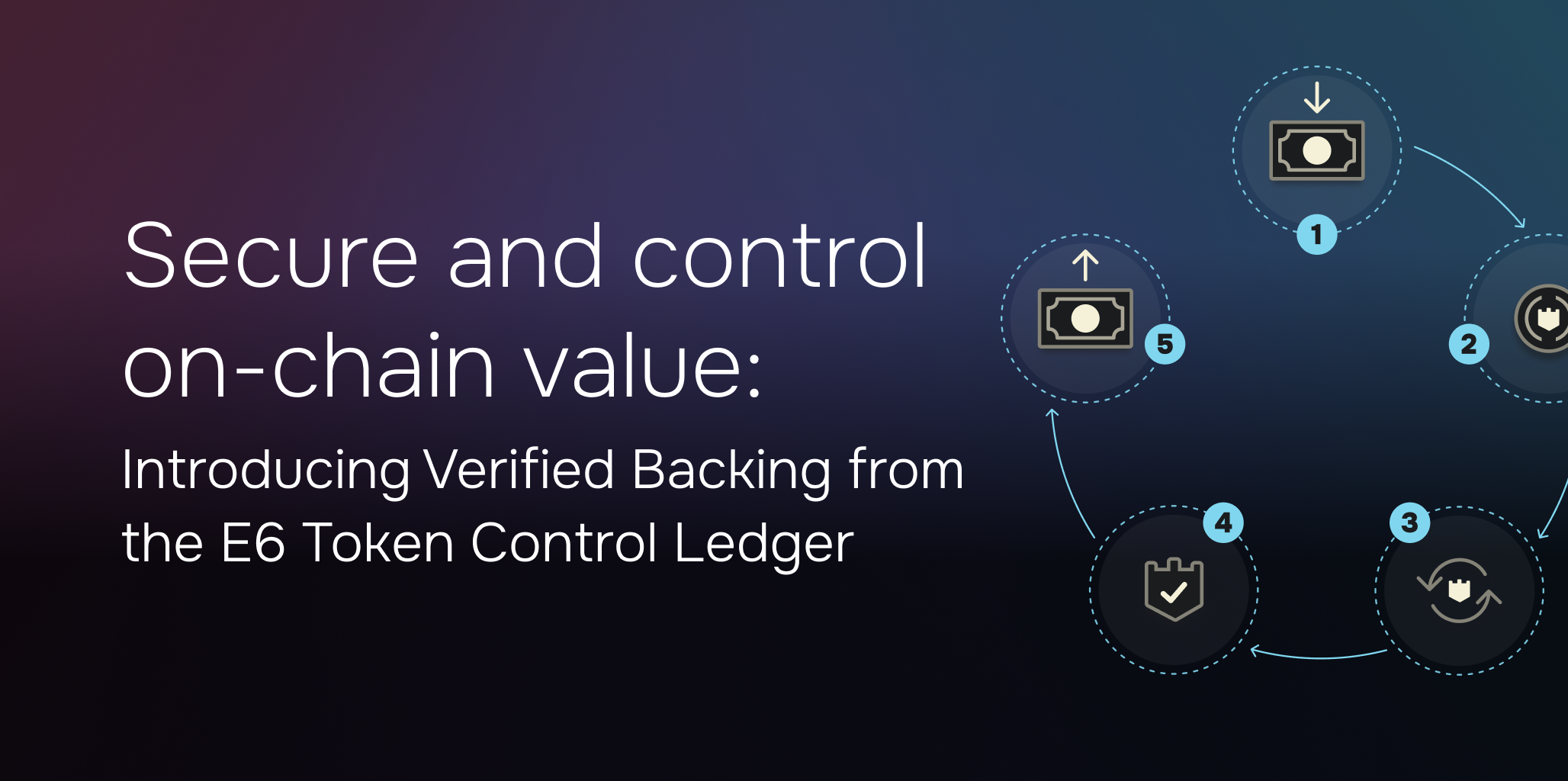
The process follows the token from creation through redemption.
1. The bank records the funds
A customer requests the creation of a tokenized deposit, stablecoin or another bank-issued tokenized payment instrument.
The corresponding funds are recorded on the Episode Six ledger, establishing the bank-side position behind the proposed token.
2. The bank authorizes issuance
Once the funds have been confirmed, the Token Control Ledger authorizes the token. The system instructs the relevant wallet or blockchain infrastructure to create it.
At issuance, a cryptographically verifiable certificate establishes the relationship between the token and the funds backing it.
3. The token moves on-chain
The token can then move through supported wallets and blockchain networks. The blockchain records its on-chain movement, while the underlying funds remain with the issuing bank.
Episode Six continues to provide the bank-side control and verification layer. The token can move without forcing the bank to surrender control over the value behind it.
4. Redemption triggers verification
When the token is presented for redemption, the request returns through the bank-side control layer.
The E6 Token Control Ledger verifies the certificate associated with the token and checks that the request corresponds to a valid, outstanding issuance.
This verification applies regardless of how many supported wallets or networks the token has passed through.
5. Funds are released after verification
If the token and redemption request match the issuance record, the bank can complete the redemption.
If they do not match, the request can be stopped before the corresponding funds leave the institution.
Bank-side infrastructure for tokenized money
Episode Six sits on the bank side of the token’s funds flow.
Blockchain networks and external wallets remain outside the bank’s perimeter. The E6 Token Control Ledger provides the orchestration and verification layer that connects those environments with the bank’s funds and records.
The E6 Token Control Ledger helps the bank maintain control over:
The blockchain provides the network for moving tokens. The bank remains responsible for the money it issues and the funds behind it.
Issue with confidence and stay in control
As threats against security in digital money continue to evolve, banks need a safeguard. With Verified Backing, banks have a real-time check against every token and every transaction.
About Episode Six
Episode Six is The World’s Local Processor ®. As a global provider of enterprise-grade card issuing and ledger infrastructure for financial technology companies, banks, and brands, Episode Six delivers the innovative capabilities needed to compete with disruptors and lead the market. Flexibility, adaptability, and resilience are built into the core of Episode Six's platform, ensuring clients maintain a market-leading position. Episode Six operates in over 50 countries, powering millions of accounts and billions in payments globally, with an expanding team located in the US, Canada, UK, Europe, Japan, Singapore, Hong Kong, Australia, and India. Investors include HSBC, Mastercard, SBI Investment Co Ltd, Anthos Capital, Avenir, and Japan Airlines.

E6 Team
About the Author
Episode Six provides financial institutions with solutions for legacy payment stacks that aren’t fulfilling the needs of an expanding industry. We are a global provider of enterprise-grade payment technology and ledger management infrastructure for banks that need to keep pace with disruptors and evolving consumer preferences.